

A self transfer flight is a travel arrangement where a passenger books two or more separate flights independently, rather than purchasing a single connecting itinerary through one airline or booking platform. In a self-transfer flight, the traveller is personally responsible for managing the connection between flights, including collecting and re checking baggage, passing through immigration or customs if required, and ensuring they reach the departure gate for the next flight on time. Unlike a traditional connecting flight, there is no airline protection if the first flight causes a missed connection.
Self transfer flight meaning goes beyond just booking two tickets. It is a strategy used by budget travellers and frequent flyers to save money or reach destinations not served by a single airline. While self-transfer flights can offer significant cost savings, they also come with real risks that every traveler must understand before booking. This complete guide covers everything you need to know about self-transfer flights, including how they work, their pros and cons, and expert tips to make your journey smooth and stress free.
Self Transfer Flight
A self transfer flight refers to a journey where you book two or more separate flights on your own, connecting them manually without the airline or booking platform creating an official link between the tickets. Each ticket is treated as a completely independent booking.
For example, if you fly from Lahore to Dubai on one airline and then book a separate ticket from Dubai to London on a different airline, you are making a self-transfer. The two airlines have no communication with each other. If your first flight is delayed and you miss your second flight, the second airline has zero obligation to rebook you for free.
This is fundamentally different from a standard connecting flight, where the airline manages the connection and takes responsibility if something goes wrong.
How Does a Self Transfer Flight Work
Here is a step-by-step breakdown of how a self-transfer flight works in practice:
- You search and book Flight A independently (for example, Lahore to Istanbul)
- You search and book Flight B independently (for example, Istanbul to Amsterdam)
- Both bookings exist as separate reservations with separate confirmation numbers
- At your layover city, you collect your baggage from Flight A
- You re-check your baggage for Flight B at a different check-in counter
- You pass through security, and possibly customs or immigration again
- You board Flight B and continue your journey
There is no automatic coordination between the two flights. The entire management of the transfer rests on your shoulders.
Self Transfer vs Connecting Flight vs Layover
Many travelers confuse these three terms. Here is a clear comparison:
| Feature | Self Transfer Flight | Connecting Flight | Simple Layover |
|---|---|---|---|
| Booked by | Traveler independently | One airline or platform | One airline |
| Baggage handling | You collect and re check | Airline transfers automatically | Airline transfers automatically |
| Missed connection protection | None | Airline responsible | Airline responsible |
| Cost | Usually cheaper | Standard or higher | Standard |
| Risk level | High | Low | Low |
| Best for | Budget travelers | Convenience seekers | Regular flyers |
Understanding this table is essential before you decide which type of booking to make. Self transfer flights require far more personal planning and carry greater risk.
Why Do Travelers Choose Self Transfer Flights
Despite the added complexity, millions of travelers choose self-transfer flights every year. Here are the most common reasons:
- Significant cost savings, sometimes hundreds of dollars per trip
- Access to routes not available through a single airline
- Ability to mix budget and full-service airlines on the same journey
- Flexibility to choose the best airline for each leg of the trip
- Opportunity to extend a layover into a mini stopover visit
- Access to better flight times or preferred seat classes
- Combining loyalty programs from multiple airlines to earn more miles
The Risks of Self Transfer Flights
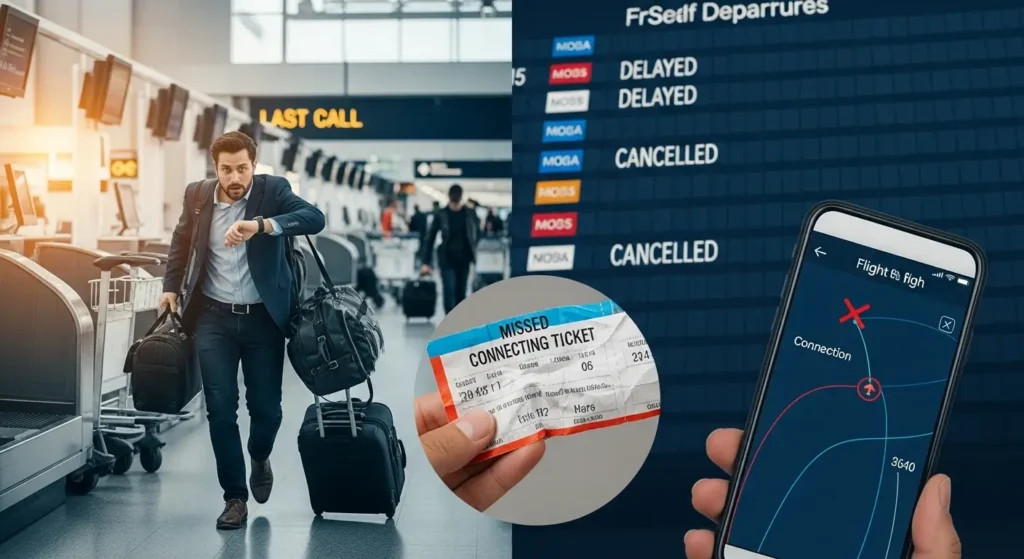
Self-transfer flights are not for every traveler. The risks are real and can turn a budget trip into an expensive nightmare. Here are the key dangers to understand:
Missed Connections If your first flight is delayed and you miss your second flight, you are fully responsible for the cost of rebooking. The second airline owes you nothing. Before booking a self-transfer, it is worth reading up on your flight delay rights guide so you go in prepared rather than blindsided at the gate.
Baggage Problems Your bags will not automatically transfer between flights. You must collect them, clear customs if required, and re-check them. If you are short on time, this can be extremely stressful.
No Airline Assistance With a standard connecting flight, the airline staff will guide you during disruptions. With a self-transfer, you are on your own.
Visa and Immigration Complications Depending on your nationality and the transit country, you may need a transit visa just to pass through the airport. A self transfer may also require you to officially enter a country to re-check your bags.
Different Terminals Your two flights may depart from entirely different terminals, requiring a bus or train transfer within the airport.
How Much Time Should You Allow for a Self Transfer
One of the most important decisions when booking a self transfer flight is choosing a safe connection time. Here is a practical guide:
| Airport Type | Minimum Recommended Connection Time |
|---|---|
| Small regional airport | 1.5 to 2 hours |
| Medium international airport | 2 to 3 hours |
| Large hub airport (e.g., Dubai, Heathrow, Frankfurt) | 3 to 4 hours |
| Airport requiring terminal change | Add 45 to 60 minutes extra |
| Airport where customs or immigration is required | Add 60 to 90 minutes extra |
Always give yourself more time than you think you need. Delays, long queues, and unexpected baggage issues are common in busy airports.
Self Transfer Flight Tips

If you are planning a self transfer flight, follow these expert tips to reduce your risk and make the journey smoother:
- Always research the airport layout before you travel so you know exactly where to go upon landing
- Book your flights with generous connection times, especially at large or unfamiliar airports
- Pack light and use carry on luggage only whenever possible to skip the baggage re-check entirely
- Purchase travel insurance that covers missed connections due to flight delays
- Check visa and transit requirements for your nationality at the layover country
- Download the apps for both airlines and enable notifications for real time flight updates
- Arrive at the airport early for your first flight so delays are less likely to cascade
- Keep all travel documents, boarding passes, and booking confirmations easily accessible
- Know the rebooking policy of your second airline in advance so you are prepared if things go wrong
- Consider booking flights on the same day and choosing morning flights, which statistically have fewer delays
Self Transfer Flights and Baggage
Baggage is one of the biggest challenges in a self transfer flight. Because your two flights are not linked, the first airline cannot send your bags directly to your final destination.
Here is what typically happens:
- You land at your layover city and proceed to the baggage claim area
- You collect all your checked bags
- You go to the check-in counter of your second airline
- You re-check your bags for the second flight
- You go through security again and proceed to your gate
This entire process takes time. If you are traveling with heavy checked baggage and you have a tight connection window, you are taking a significant risk. The safest strategy is to travel with carry on luggage only during a self transfer. Every airline has different rules on bag sizes and weights, so reviewing the latest airline baggage policies and packing tips before you travel can save you from unexpected fees or delays at the check in counter.
Customs and Immigration During a Self Transfer
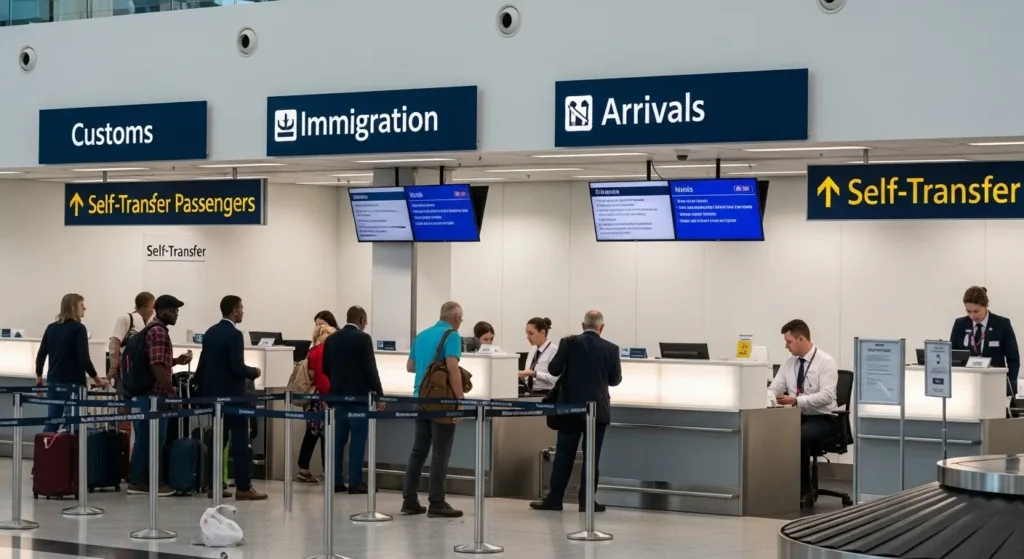
One aspect of self transfer flights that catches many travellers off guard is the customs and immigration process. Because your two flights are not officially linked, you are often required to clear immigration at the layover country, collect your bags, and then re-enter the departure area as a new passenger.
This process varies significantly depending on the country and airport. Some airports have a dedicated transit area that allows passengers to remain airside without passing through immigration, while others require all passengers with checked luggage to exit the secure zone completely. Understanding where you go through customs when you have a connecting flight is essential knowledge before attempting a self-transfer, especially at large international hubs where the process can be lengthy.
Key things to check before you book:
- Does your nationality require a transit visa for the layover country
- Does the airport allow airside transit or must you clear immigration
- How long does the customs process typically take at that airport
- Is there a dedicated fast-track lane available for transit passengers
Do You Need Travel Insurance for a Self Transfer Flight
Yes, absolutely. Travel insurance is not optional when you book a self-transfer flight, it is essential. Here is what a good travel insurance policy should cover for self-transfer situations:
- Missed connection coverage due to a delayed first flight
- Rebooking costs for a missed second flight
- Accommodation costs if you are stranded overnight
- Emergency assistance and 24/7 support line
- Baggage delay or loss coverage
Read the policy carefully before purchasing. Some travel insurance plans exclude missed connections that result from a self-transfer booking. Look specifically for policies that cover self-connecting flights or independently booked tickets.
Self Transfer Flights at Popular Hub Airports
Some airports are better suited for self transfer flights than others. Here is a quick overview:
| Airport | Self Transfer Friendliness | Key Notes |
|---|---|---|
| Dubai International (DXB) | High | Compact, well signposted, efficient customs |
| Istanbul Airport (IST) | High | Modern, large but navigable |
| London Heathrow (LHR) | Medium | Multiple terminals, allow extra time |
| Frankfurt Airport (FRA) | Medium | Two terminal buildings, train needed |
| Bangkok Suvarnabhumi (BKK) | High | Single terminal, efficient layout |
| New York JFK | Low | Multiple terminals, long transfer times |
| Paris Charles de Gaulle (CDG) | Low | Confusing layout, delays common |
Who Should Consider Self Transfer Flights
Self-transfer flights are best suited for:
- Experienced travelers who are comfortable navigating airports independently
- Budget-conscious travelers who are willing to accept more risk to save money
- Travelers with flexible schedules who can handle a potential overnight delay
- Backpackers and solo travelers traveling light with carry-on only
- Frequent flyers who know specific airports very well
Self-transfer flights are not recommended for:
- First-time international travelers
- Families traveling with young children
- Travelers with strict deadlines such as a cruise departure or a business meeting
- Anyone who cannot afford unexpected rebooking or hotel costs without insurance
Final Thoughts
A self-transfer flight can be an excellent way to save money and access destinations that are difficult to reach with a single booking. However, it requires careful planning, realistic timing, and the right travel insurance. The self-transfer flight meaning is ultimately about taking control of your own journey, with all the freedom and responsibility that comes with it.
If you go in prepared, with generous connection times, carry on luggage, and solid travel insurance, a self-transfer flight can work out perfectly. If you rush it or underestimate the complexity, it can become one of the most stressful travel experiences of your life.
Plan smart, give yourself time, and always have a backup plan.