
Transferring a plane ticket to someone else is not allowed by most major airlines. Flight tickets are non-transferable by default because they are issued in the passenger’s name and must match a government-issued ID or passport at the airport. Airlines like American, Delta, and United strictly prohibit full ticket transfers for security, fraud prevention, and revenue protection reasons. However, minor name corrections such as fixing a typo or a misspelling are permitted by most carriers, usually for free or a small fee, if requested well before the departure date.
If you cannot use your plane ticket, you still have options instead of a full transfer. You may cancel the ticket and apply for a refund or travel credit, file a claim through your travel insurance, or contact the airline directly to explain your situation as some carriers make exceptions for medical emergencies or bereavement cases. A few airlines like Emirates and Air India do allow a one-time name change on select fares for a fee ranging from $100 to $300, but this is rare. The safest way to avoid losing money on an unused ticket is to purchase a flexible or refundable fare and always buy travel insurance at the time of booking.
Understanding Airline Ticket Transfer Policies
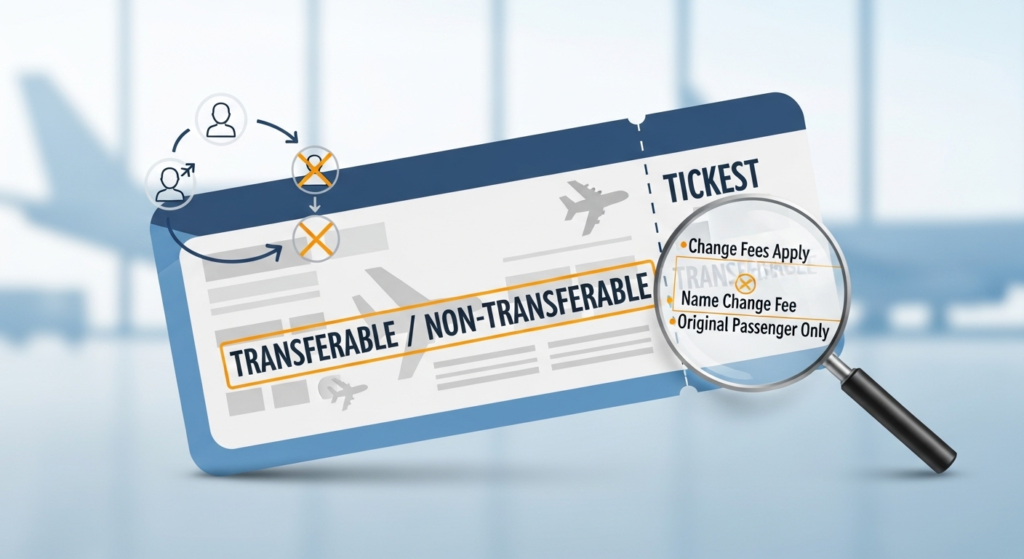
Flight tickets are almost universally non-transferable under standard airline policies. When you purchase a ticket, it is issued in your name and tied directly to your passport or government issued ID. Airlines and aviation authorities require passengers to match the name on the boarding pass with the name on their travel documents which means you cannot simply hand a ticket to someone else as you might resell a concert ticket.
However, there is an important distinction that many travellers confuse: a name correction is not the same as a ticket transfer. Most airlines will allow minor corrections to a name such as fixing a typo or a misspelling but very few will allow you to change the ticket to a completely different person. Understanding this difference is crucial before you call customer support.
Why Airlines Restrict Ticket Transfers
Airlines have several strong reasons for making tickets non-transferable:
- Security compliance: Aviation security regulations require that the name on the ticket matches the ID presented at the airport.
- Revenue protection: If tickets were freely transferable, airlines would lose control over pricing, and passengers could resell tickets at a profit, undermining the airline’s fare structure.
- Fraud prevention: Non-transferability helps airlines prevent ticket fraud, unauthorized reselling, and money laundering schemes.
- Operational integrity: Airlines need to know exactly who is on each flight for manifest accuracy and emergency response purposes.
- Legal obligations: In many countries, aviation regulations legally require name-ID matching, making ticket transfers not just a policy choice but a legal requirement.
Name Correction vs Full Ticket Transfer: What’s the Difference
This is perhaps the most misunderstood aspect of flight ticket policies. The table below clearly outlines the key differences between a name correction and a full ticket transfer so you know exactly what to expect when you contact your airline.
Name Correction vs. Full Ticket Transfer
| Factor | Name Correction | Full Ticket Transfer |
|---|---|---|
| Definition | Fixing a typo or small error in the existing passenger’s name | Changing the ticket to a completely different person |
| Allowed By | Most airlines (usually up to 3–4 characters) | Very few airlines; mostly charter or low-cost carriers |
| Fees | Free to $50 depending on airline | $100–$500+ or not possible at all |
| Time Limit | Up to 24–72 hours before departure | Usually 24–48 hours before departure if allowed |
| Documentation | Passport or ID showing correct name | Full ID of new passenger, original booking details |
| Availability | Most fare classes | Business/flexible fares only, rare exceptions |
As the table shows, name corrections are relatively accessible and affordable, while full ticket transfers are either extremely rare or outright impossible with most major carriers. If you realize there’s a minor typo in your name right after booking, act quickly most airlines allow free corrections within 24 hours of purchase.
Major Airline Transfer Policies at a Glance
Every airline has its own set of rules. The table below summarizes the transfer and name change policies of some of the world’s major carriers. Always verify directly with the airline, as policies can change without notice. You can review the full breakdown in our Emirates flight change and refund policy guide.
Airline by Airline Ticket Transfer & Name Change Policy Overview
| Airline | Transfer Allowed? | Name Change Fee | Conditions |
|---|---|---|---|
| American Airlines | No | Not Applicable | Tickets are non-transferable; cancel and rebook required |
| Delta Air Lines | No | Not Applicable | Non-transferable; same-day changes allowed under certain fares |
| United Airlines | No | Not Applicable | Tickets are non-transferable; credits may be issued on cancellation |
| Southwest Airlines | Partial | Free | No formal transfer, but name corrections allowed for free |
| British Airways | Limited | $50–$200 | Minor name corrections allowed; full transfers generally not permitted |
| Emirates | Yes (limited) | $100–$300 | Name change permitted once before departure; fees apply |
| Lufthansa | Limited | €50–€200 | Minor corrections only; full name transfers not allowed on most fares |
| Air India | Yes (limited) | INR 2,000–5,000 | Name change allowed up to 24 hours before departure on select fares |
As you can see, the vast majority of major carriers do not allow full ticket transfers. Some airlines like Emirates and Air India do permit a one-time name change under certain conditions, but this still must be the same passenger type and may carry significant fees. Southwest Airlines is often cited as the most flexible U.S. carrier due to its free rebooking and name correction policies, though it doesn’t formally allow transfers either.
When Ticket Transfers Are Possible: Special Scenarios

1. Charter Flights and Tour Operators
Charter flights and packages booked through tour operators are sometimes more flexible with name changes and transfers. If you’ve purchased a package holiday through a travel agency, the agency itself may allow you to transfer the booking to another person, often for a flat administrative fee. This is one of the few legitimate cases where a ticket transfer might be straightforward.
2. Business and First Class Flexible Fares
Some premium flexible fare types especially in business or first class come with more lenient change and cancellation policies. While full transfers to another person are still rare, these fares are far more likely to offer refunds, travel credits, or free rebooking that can effectively achieve a similar result.
3. Compassionate or Bereavement Circumstances
Many airlines have unpublished policies for exceptional circumstances such as the death of a close family member or a serious medical emergency. If you contact the airline’s customer service and explain your situation, they may waive fees or make exceptions that aren’t listed in their official policy. It always helps to have documentation such as a death certificate or a letter from a doctor.
4. Codeshare and Partner Airline Situations
If your ticket involves multiple airlines through a codeshare arrangement, the rules can become more complex. The operating airline’s policy typically applies, but the ticket-issuing airline may also impose conditions. Always check with both carriers in such cases.
What to Do If You Cannot Transfer Your Ticket
If your airline won’t allow a transfer, don’t panic. There are several practical alternatives available to you, each suited to different circumstances. The table below outlines your main options and when to use them. If you are not ready to pay immediately when booking in the future, you may also want to learn hold a flight ticket without paying to reduce risk
Alternatives to Ticket Transfer
| Option | How It Works | Best For |
|---|---|---|
| Cancel & Rebook | Cancel your ticket and let the other person book a new one | Refundable tickets or travel credits |
| Travel Credit / Voucher | Use the credit yourself for a future flight on the same airline | People who travel frequently on the same airline |
| Travel Insurance Claim | File a claim if unable to travel due to covered reasons (illness, emergency) | Unexpected medical or family emergencies |
| Resell the Ticket | Sell informally (usually against airline T&Cs; carries risk) | Last resort; not recommended due to legal risks |
| Contact Airline Directly | Explain your situation; agents sometimes make exceptions for hardship | Compassionate cases: death in family, serious illness |
Cancelling and Rebooking: The Most Common Solution
For most people, cancelling the original ticket and having the intended traveler book a new one is the most straightforward solution. This works best when:
- Your ticket is fully refundable or comes with a travel credit option.
- The new traveler can find a seat on the same flight at a comparable price.
- You have enough advance notice to avoid last-minute cancellation penalties.
Check your fare rules carefully before cancelling. Basic economy tickets are often non refundable and may only offer a travel credit minus a cancellation fee, which reduces the effective value you recover.
Travel Insurance: A Smart Safety Net

Travel insurance is one of the most underused protections in the aviation industry. If you purchase a travel insurance policy that includes trip cancellation coverage, you may be able to recover some or all of the ticket cost if you can’t travel due to a covered reason such as illness, injury, a family emergency, or even job loss in some cases.
Key things to keep in mind about travel insurance:
- You must typically purchase the policy within a set window after booking often 14 to 21 days to get maximum coverage.
- Not all reasons for cancellation are covered; read the policy fine print carefully.
- “Cancel for Any Reason” (CFAR) add-ons offer broader coverage but at a higher premium.
- Claims require documentation; keep all relevant records and receipts.
- Some credit cards include travel insurance as a cardholder benefit check before buying a separate policy.
Step by Step: How to Request a Name Change or Correction
If you simply need to fix a name error (rather than transfer the ticket to a different person), here’s how to handle it efficiently:
- Step 1: Act quickly. Contact the airline as soon as you notice the error. Many airlines allow free corrections within 24 hours of booking.
- Step 2: Gather documentation. Have your passport, ID, and booking confirmation ready before you call or log in to the airline’s website.
- Step 3: Use the right channel. Some airlines handle name corrections online through “Manage My Booking”; others require a phone call to customer support.
- Step 4: Understand the fee structure. Ask clearly whether the correction will incur a fee, and get confirmation in writing (email or chat transcript).
- Step 5: Verify the change. After the correction is processed, double-check your new boarding pass or itinerary to ensure the name matches your travel document exactly.
- Step 6: Check transit and connecting flights. If your journey involves multiple carriers, ensure that any name change is reflected across all segments of the booking.
Tips to Avoid Ticket Transfer Problems in the Future
Prevention is always better than cure. Here are some proactive steps you can take to avoid finding yourself in a situation where you need to transfer a flight ticket:
- Always double-check the name during booking before completing the purchase. Entering names exactly as they appear on your passport eliminates the most common cause of name issues.
- Purchase refundable or flexible fares when your travel plans are uncertain, especially for international trips.
- Buy travel insurance at the time of booking, not after your plans change.
- Use a credit card with travel benefits many premium cards offer trip cancellation protection and name change assistance.
- Book directly with the airline rather than through a third-party OTA (Online Travel Agency) when possible. Third-party bookings can add an extra layer of complexity to any changes or corrections.
- Read the fare rules before purchasing, especially for international flights where tickets tend to be more expensive and the stakes are higher.
Final Thoughts
The short answer to “Can you transfer a flight ticket to someone else?” is: almost never, at least not with major commercial airlines. The aviation industry is built around identity verification and security, which makes ticket transfers fundamentally at odds with how the system works. However, understanding your options from name corrections and compassionate exceptions to travel insurance and flexible fares puts you in a far better position to handle unexpected changes to your travel plans.
If you find yourself stuck with a ticket you can’t use, your best bet is to contact the airline immediately, know your fare rules, and explore cancellation and credit options before assuming the ticket is a total loss. A calm, informed conversation with customer service goes a long way, and in some cases, airlines will bend their official policies for passengers who explain their situation clearly and respectfully.
Travel smarter by planning for uncertainty and you’ll rarely find yourself in a situation where a ticket transfer is your only hope.