
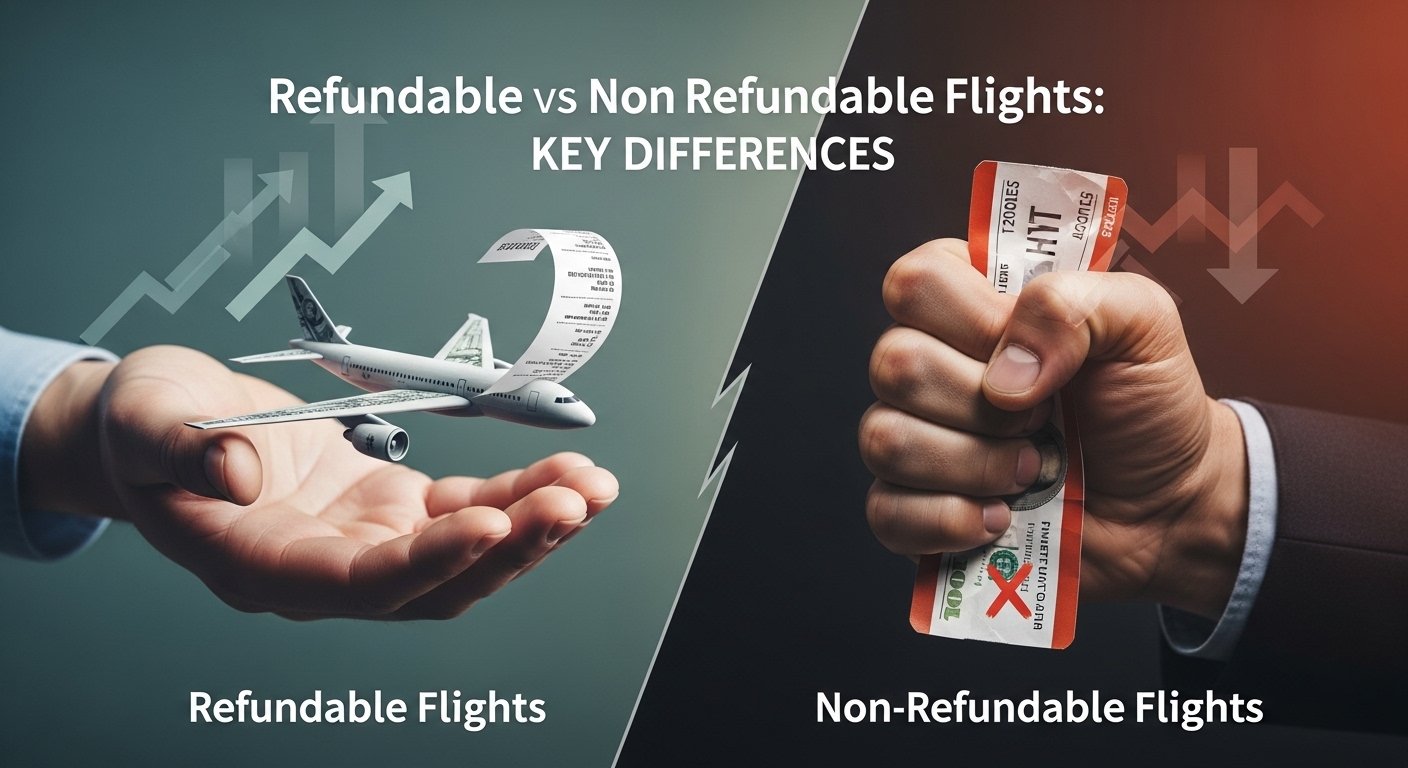
When booking a flight, one of the most important decisions travellers face is choosing between refundable vs non refundable flights. Refundable flights allow passengers to cancel their ticket and receive a full or partial refund, offering flexibility and peace of mind but they typically come at a higher price. Non refundable flights, on the other hand, are significantly cheaper but come with strict cancellation policies, meaning you may lose the entire ticket cost if your plans change.
Understanding the difference between refundable and non refundable flights can save you both money and stress. Refundable tickets are ideal for travellers with uncertain schedules, frequent business flyers, or those booking far in advance. Non refundable tickets work best when your travel plans are fixed and you’re looking to cut costs. Before booking, always compare the price difference, airline cancellation policies, and whether travel insurance could bridge the gap so you make the smartest choice for your trip.
What Is a Refundable Ticket
A refundable airline ticket, often sold under fare classes labelled as “Fully Flexible,” “First Class Refundable,” or simply “Refundable Economy,” is a ticket that allows the passenger to cancel their booking and receive a full or near-full refund to their original payment method typically a credit or debit card without incurring a significant penalty.
Refundable tickets usually come with the highest fare class codes (such as Y or B for economy class), meaning they represent the most expensive seats on the aircraft. Airlines price them at a premium specifically because the airline assumes the financial risk. If you cancel, they must potentially sell that seat again at a lower price, or lose that revenue entirely. If you are flying with Spirit Airlines, it helps to review whether you can cancel a Spirit flight and still get a refund before assuming your ticket is fully lost.
Key characteristics of refundable tickets include: the ability to cancel or change your flight without penalty fees; a full cash refund returned to your original payment method; access to more seat inventory, including upgrades; and priority boarding or checked baggage allowances on some carriers.
Refundable fares are especially prevalent in business and first class cabins, where airlines compete for corporate accounts that demand maximum flexibility. However, many major carriers now offer refundable economy fares as a separate tier, often referred to as “Main Cabin Refundable” or “Economy Flex.”
What Is a Non Refundable Ticket
Non-refundable tickets are the standard fare type sold on most airline websites and third-party booking platforms. They are priced lower because the passenger bears the risk of cancellation if you cannot take your flight, the airline keeps your money or issues a travel credit, not a cash refund.
The term “non-refundable” can be somewhat misleading. In many cases, you are not forfeiting the entire ticket value you may receive a credit toward a future flight, minus a change or cancellation fee. However, this credit is often subject to expiration dates, blackout periods, and may not be transferable to another person.
Non-refundable tickets typically involve: no cash refund upon cancellation; travel credits that expire within 12 months; change fees ranging from $50 to over $300 depending on the airline and route; and fare difference charges if you rebook on a more expensive flight.
It is worth noting that U.S. Department of Transportation (DOT) regulations do require airlines to provide a full refund on any ticket refundable or not if the airline cancels or significantly changes the flight. This is an important consumer protection that many travellers are unaware of, and it applies regardless of what the fare rules say.
Side by Side Comparison at a Glance
The following table summarizes the most important differences between refundable and non refundable tickets to help you quickly evaluate your options:
| Feature | Refundable Tickets | Non-Refundable Tickets |
| Average Cost | High (2x–5x more) | Low to Moderate |
| Cancellation Refund | Full cash refund | No cash refund (credit only) |
| Change Fees | None or minimal | $50–$300+ per change |
| Flexibility | Very high | Low to moderate |
| Seat Upgrades | Often included | Extra cost |
| Best For | Business, uncertain plans | Leisure, fixed plans |
| Miles/Points Earning | Full earning rate | Reduced rate |
The True Cost Difference
The price gap between refundable and non-refundable tickets varies significantly by airline, route, cabin class, and how far in advance you are booking. On a domestic U.S. route, a non-refundable economy ticket might cost $180, while the refundable equivalent on the same flight could be $550 or more a premium of over 200 percent.
On international long-haul routes, the difference can be even more dramatic. Business class refundable fares on transatlantic routes frequently run two to four times the cost of a non-refundable business ticket, with the refundable option sometimes exceeding $10,000 for a round trip that could be booked non-refundable for $3,000–$4,000.
From a purely financial standpoint, the refundable ticket makes sense only if there is a meaningful probability that you will need to cancel or change your plans. If you are confident you will fly, the money saved on a non-refundable ticket can be substantial — enough to pay for travel insurance, hotel upgrades, or even an additional trip.
A useful rule of thumb: if the refundable fare premium is less than the cost of travel insurance that would cover cancellation for your specific reasons, consider buying the non-refundable ticket and insuring it instead. This strategy often provides equivalent or better protection at a lower total cost.
When Should You Buy Each Type
Choosing between refundable and non-refundable tickets depends heavily on your personal travel patterns, risk tolerance, and financial situation. Below is a practical scenario-based guide to help you decide:
| Travel Scenario | Recommended Ticket Type | Reason |
| Business trip with uncertain meeting dates | Refundable | Schedule may change last minute |
| Annual family vacation, dates fixed | Non-Refundable | Saves significant money, low risk |
| Medical condition or elderly traveler | Refundable or Travel Insurance | Health-related cancellations are common |
| Short weekend trip, budget-conscious | Non-Refundable | Price difference not worth flexibility |
| International trip booked months ahead | Non-Refundable + Insurance | Insurance covers unforeseen events cheaply |
| Startup founder with shifting travel plans | Refundable | Constant schedule changes justify the cost |
How Major Airlines Handle Refundable and Non Refundable Fares
Airline policies on refundable and non-refundable fares have evolved considerably in recent years. During the COVID-19 pandemic, most major U.S. carriers eliminated change fees on standard economy and premium cabin tickets, which blurred the traditional line between refundable and non-refundable fares. However, this does not mean non-refundable tickets became refundable it simply means changing your flight date no longer costs extra on many domestic routes. Each airline applies its own policy structure.
The following table provides a general overview of how major airlines currently handle these fare types. Policies can change, so always verify with the airline directly before booking:
| Airline | Non-Refundable Change Fee | Cancellation Credit | Refundable Fare Premium |
| Delta Air Lines | $0 (most domestic) | eCredit (1 yr) | Up to 4x base fare |
| American Airlines | $0 (most domestic) | Trip credit (1 yr) | Up to 5x base fare |
| United Airlines | $0 (most routes) | Future flight credit | 3x–4x base fare |
| Southwest Airlines | $0 always | Travel funds (yr) | No separate refundable tier |
| Budget Airlines (Spirit, Frontier) | $49–$119 | Partial credit only | Limited availability |
One airline worth highlighting separately is Southwest Airlines, which has long operated without traditional change or cancellation fees on any of its fares. While Southwest does not officially sell “refundable” and “non-refundable” tickets in the same way other carriers do, its Wanna Get Away fares function like non-refundable tickets (travel funds, not cash), while its Anytime and Business Select fares are fully refundable to the original payment method. Southwest’s model is often cited as the most consumer-friendly in the industry.
The Role of Travel Insurance

For travelers who are uncomfortable with the risk of a non-refundable ticket but unwilling to pay the refundable premium, travel insurance is often the most practical middle ground. A comprehensive travel insurance policy can cover trip cancellation for a wide range of covered reasons — illness, injury, death of a family member, natural disaster, jury duty, and more and reimburse you for the non-refundable portion of your ticket at a fraction of the cost of the refundable fare.
Standard travel insurance policies typically cost between 4 and 10 percent of the total trip cost. On a $500 non-refundable ticket, that is $20–$50 far less than the difference between a non-refundable and refundable fare. Cancel For Any Reason (CFAR) coverage, which is an optional upgrade on most policies, allows you to cancel for literally any reason and recoup up to 75 percent of your trip cost, offering near-refundable flexibility at a significantly reduced price.
It is important to read travel insurance policies carefully. “Cancel for Work Reasons” coverage, for instance, is often sold as an add-on rather than a standard benefit. Make sure the policy covers the specific scenarios most likely to affect your travel plans.
Credit Card Trip Cancellation Protections

Many premium travel credit cards including those issued by Chase, American Express, Citi, and Capital One include built-in trip cancellation and trip interruption insurance as a cardholder benefit. If you purchase your non-refundable ticket with such a card and must cancel for a covered reason, the credit card’s benefit may reimburse you for the non-refundable ticket cost, up to a per-trip limit (often $5,000–$10,000).
This is an often underutilized protection that can effectively make a non-refundable ticket behave like a refundable one in many common cancellation scenarios illness, severe weather, job loss without any additional cost beyond the card’s annual fee.
Before relying on credit card trip cancellation benefits, review the terms carefully. Coverage is typically secondary to any insurance you already have, and it applies only to covered reasons, not all cancellations.
Regulatory Protections You Should Know
Beyond airline policies and insurance, travelers in the United States have important federal protections under U.S. Department of Transportation regulations. Under current rules, airlines are required to offer a full refund to the original form of payment if they cancel a flight or make a significant change regardless of the fare type purchased.
What constitutes a “significant change” has historically been left to airline interpretation, but the DOT has in recent years moved toward more defined standards, including schedule changes of three or more hours for domestic flights. The agency has also increased scrutiny of how airlines define and advertise refundable fares, with several enforcement actions against carriers that misleadingly classified certain tickets as refundable when they were not.
European travellers enjoy even stronger protections under EU Regulation 261/2004, which mandates compensation of up to €600 per passenger for flight cancellations and significant delays, regardless of ticket type. This regulation applies to all flights departing from EU airports and to EU-based carriers flying into the EU.
Practical Tips for Booking Smarter

Understanding refundable versus non-refundable fares is only part of the equation. Here are several actionable strategies to maximize your flexibility while minimizing cost. If you are not fully ready to commit to payment, another useful option is learning how to hold a flight ticket without paying, which can give you time to compare refundable and non-refundable pricing before finalising your decision.
Book directly with the airline. Third-party platforms like Expedia or Google Flights may offer lower upfront prices, but they add a layer of complexity when you need to cancel or change. Airlines can often process changes more quickly when you book directly, and refunds are typically faster.
Use the 24-hour cancellation window. Under DOT rules, airlines must allow passengers to cancel any ticket booked at least seven days before departure within 24 hours of purchase for a full refund regardless of the fare type. This gives you a brief window to book speculatively and then cancel if your plans change within a day.
Watch for fare sales on refundable tickets. Occasionally, airlines run promotions that significantly reduce the premium on refundable fares, particularly in business class. Setting fare alerts on platforms like Google Flights or Kayak for your desired route and date range can help you catch these windows.
Consider mixing fare types on multi-leg trips. On a complex itinerary, it may make sense to purchase refundable fares only for the legs most likely to change such as the outbound flight timed around a business meeting while using non-refundable fares for the return leg, where your schedule is fixed.
Conclusion
The choice between a refundable and a non-refundable flight ticket is rarely just about the sticker price. It involves an honest assessment of how likely your plans are to change, what risks you are exposed to, and what tools travel insurance, credit card protections, airline policies you have available to mitigate those risks.
For most leisure travelers with fixed itineraries, a non-refundable ticket paired with a good travel insurance policy represents the best value. For business travelers, frequent flyers, or anyone facing genuine uncertainty about their travel dates, the premium paid for a refundable ticket is often a sound investment that prevents far greater losses down the road.
Armed with the information in this guide, you are now better equipped to evaluate your options, read the fine print, and make the airfare decision that truly fits your needs not just the one that looks cheapest at checkout.