

Whether to book flights early or last minute depends entirely on your route type, travel dates, and risk tolerance. For most domestic routes, booking 3 to 8 weeks in advance delivers the lowest fares. For international flights, the window extends to 2 to 5 months before departure. Last minute deals do exist, but they are less common today because airlines use dynamic pricing models that raise prices as seats fill. Waiting without a strategy almost always costs more.
The real decision is not early vs last minute. It is understanding when an airline is most likely to drop prices for your specific route. Budget carriers like Spirit or Ryanair rarely discount at the last minute. Flag carriers and major airlines occasionally release unsold seats at reduced rates within 48 to 72 hours of departure. Knowing which category your airline falls into is the first step toward a smarter booking decision.
Early vs Last Minute
For most travellers, booking early wins. The average savings from booking 6 to 8 weeks ahead versus 1 week before departure ranges from 20 to 45 percent on domestic routes and 30 to 60 percent on international routes.
Airlines use yield management systems that adjust seat prices hundreds of times per day. These systems are built to extract maximum revenue from each flight. As a seat gets closer to departure and demand holds steady, the price goes up, not down. Understanding why flight prices change every hour is the single most useful thing you can do before deciding when to book, because the same route can swing by 30 percent within 24 hours depending on how the algorithm reads demand. This is the core reality that makes last-minute booking a losing strategy for the majority of routes.
However, last-minute pricing breaks down in specific scenarios. When a flight is undersold close to departure, some airlines (particularly legacy carriers) drop prices to fill remaining seats. This window is typically 48 to 72 hours before departure. Catching it requires flexibility and real-time monitoring, which most travelers cannot afford.
Most travelers overpay not because they book last minute but because they book at the wrong time of day, on the wrong platform, or without comparing against the airline direct price.
| Booking Timing | Best For | Typical Savings vs Peak Price | Risk Level |
|---|---|---|---|
| 3 to 6 months ahead | Peak season, international, holidays | 40 to 60% | Very Low |
| 6 to 8 weeks ahead | Domestic routes, standard travel | 20 to 40% | Low |
| 2 to 3 weeks ahead | Flexible travelers, off-peak routes | 5 to 20% | Medium |
| 1 week ahead | Business emergencies, flexible routes | Usually 20 to 50% more | High |
| 48 to 72 hours ahead | Undersold leisure routes only | Unpredictable | Very High |
| Same day | Flexible standby travelers | Usually 2 to 4x base fare | Extreme |
Best Booking Windows by Route Type
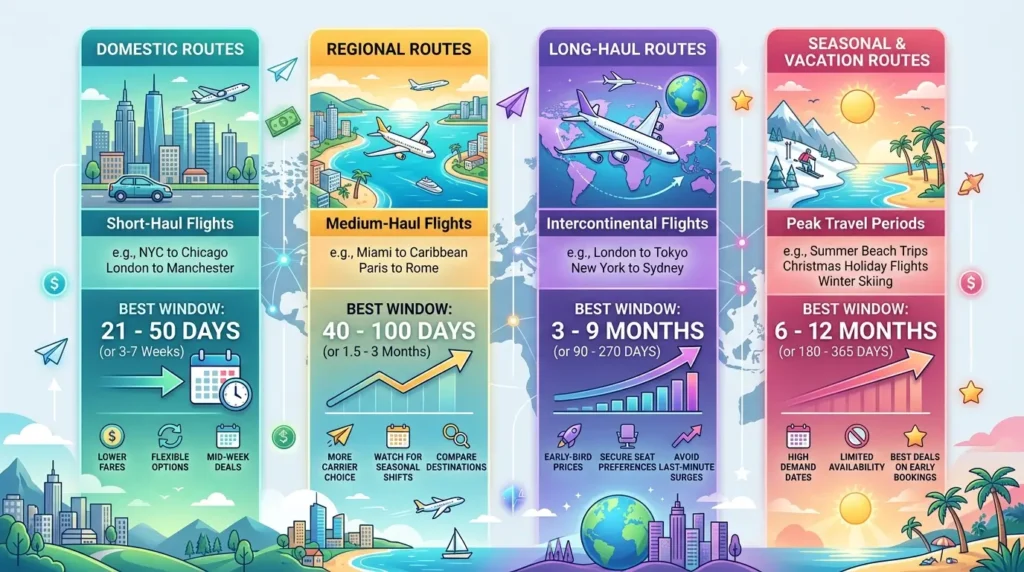
There is no single booking window that works for every trip. The right timing depends on your route category, season, and whether you are flying a budget carrier or a full service airline. Understanding your route type is the foundation of any cheap flight booking strategy. If you want a deeper breakdown of exact windows sorted by month and destination type, the best time to book cheap flights guide on Flightofly covers seasonal patterns that the table below summarises.
Domestic Flights
Book 3 to 8 weeks in advance for standard routes. Holiday travel windows (Thanksgiving, Christmas, Eid travel) should be booked 10 to 14 weeks ahead. Prices on domestic routes tend to dip mid week when corporate demand is lower.
International Short Haul
Optimal window is 6 to 10 weeks ahead for regional international routes. Budget carriers in Europe and Southeast Asia often release promotional fares 8 to 12 weeks before departure, then raise prices steadily.
Long Haul International
Book 3 to 6 months ahead for transatlantic or transpacific routes. Business class inventory drops in price 6 to 8 weeks before departure more reliably than economy, especially on routes with low corporate demand.
Budget Carrier Routes
Budget airlines almost never discount last minute. Their pricing model front-loads low fares at sale launch, then raises steadily. The best prices are at the very beginning of the booking window, often 3 to 6 months out.
| Route Type | Ideal Booking Window | When Prices Peak | Last Minute Risk |
|---|---|---|---|
| Short domestic (under 3 hrs) | 3 to 6 weeks ahead | 7 to 14 days before | Medium |
| Long domestic (over 3 hrs) | 6 to 10 weeks ahead | 10 to 21 days before | High |
| Regional international | 6 to 10 weeks ahead | 2 to 3 weeks before | High |
| Long haul international | 3 to 6 months ahead | 1 to 2 months before | Very High |
| Holiday and peak season | 3 to 5 months ahead | 6 to 8 weeks before | Extreme |
| Off-peak shoulder season | 4 to 8 weeks ahead | Varies by route | Low to Medium |
Prices on your route may already be moving. Check current fares before your window closes.
Booking Myths That Are Costing You Real Money

There are several widely repeated rules about booking flights that were either never accurate or have become outdated as airline pricing systems evolved. These myths cause travelers to make confident decisions that are actually wrong. Before you decide when to find cheap flights, it is worth knowing which advice to ignore.
Myth 1: Tuesday Is the Cheapest Day to Book
This belief originated from an observation made about ten years ago when airlines would release weekly sales on Tuesday mornings and competitors would match by Tuesday afternoon. That system no longer exists. Airlines now adjust pricing in real time, multiple times per day. Analysis of booking data from 2022 to 2024 shows less than a 1 percent average price difference between days of the week for booking. The cheapest day to book is whichever day an airline happens to release a sale or an algorithm flags undersold inventory.
Myth BustedWaiting for Tuesday to book is not a strategy. Set fare alerts on Google Flights or Skyscanner so you are notified the moment a price drops on your specific route, regardless of which day it falls on.
Myth 2: Last Minute Always Means a Deal
This idea comes from the cruise industry, where last-minute unsold cabins are often deeply discounted. Airlines work differently. Most carriers close their cheapest fare classes weeks before departure. When a seat appears available close to departure, it is almost always sitting in a high-yield fare bucket. The exceptions are specific airlines on specific routes with chronic underselling problems. These exist, but they are not the norm, and you cannot plan your travel around them reliably.
Myth 3: Booking Directly with the Airline Is Always Cheapest
Direct is not always cheapest. Online travel agencies sometimes have negotiated rates, particularly on international routes, that are lower than what appears on the airline site. The reverse is also true. The only way to know is to compare both. Always check the airline website after checking aggregators, since airlines occasionally offer exclusive discounts to direct bookers, particularly for add-ons like seat selection and baggage.
Myth 4: Clearing Cookies Lowers Flight Prices
This is one of the most persistent myths in travel. The reality is that most airline pricing is driven by server-side inventory systems, not cookies stored in your browser. The price you see is based on what fare class is available at that moment, not how many times you have visited the page. Switching browsers occasionally shows a price difference, but that is because the available fare class changed between your visits, not because of cookies. Use private browsing for peace of mind, but do not expect it to reliably save money.
The most reliable savings do not come from tricks. They come from understanding when your specific airline releases its lowest fare inventory and being ready to book at that moment.
Platform Comparison: Where You Should Actually Be Searching
Not all platforms surface prices the same way. Using just one tool to search for flights means you are almost certainly missing better options. The right approach is to use aggregators for discovery, then check airline sites before booking. Understanding the best time to book flights matters less if you are searching in the wrong place.
| Platform | Best For | Limitation | Cost Impact |
|---|---|---|---|
| Google Flights | Price tracking, date flexibility, calendar view | Does not book directly for all routes | High savings potential |
| Skyscanner | Whole month and whole year views, budget airlines | Some listed prices exclude fees | Good for flexible travel |
| Kayak | Price forecasting, alerts, hacker fares | Hacker fares involve two separate tickets | Useful for US domestic |
| Airline Website Direct | Seat selection, loyalty points, extras | No cross-airline comparison | Sometimes lowest for base fare |
| Momondo | International routes, finding obscure carriers | Interface less intuitive than Google | Often surfaces lowest prices |
| Hopper | Predictive pricing, should-I-buy notifications | Predictions not always accurate | Better for domestic US |
For most travellers, the most efficient workflow is to start on Google Flights using the explore map or calendar view to identify the cheapest travel dates. Then run the same search on Skyscanner. Finally, go directly to the airline website for the best-looking option and compare the final checkout price including all fees. This three step check takes five minutes and can save several hundred dollars on long-haul routes. You can read more in our complete cheap flight booking tips guide.
Step by Step: How to Book a Flight at the Right Time
Following a consistent method removes guesswork and emotional booking decisions. This is the exact workflow used by frequent flyers who consistently pay less than average. Check our detailed guide on finding cheap flights for advanced variations on each step.
- Determine your flexibility window. If your travel dates are fully fixed, you are in a more constrained position. If you can shift by 2 to 3 days either side, use Google Flights calendar view to identify the cheapest date cluster within your window.
- Identify your route category. Use the booking window table above to know how far in advance you should be searching. Set a reminder in your calendar for the ideal booking range if you are planning ahead.
- Set up fare alerts immediately. Do this even if you are not ready to book. Use Google Flights and Skyscanner simultaneously. Alerts cost nothing and capture drops you would otherwise miss.
- Run a three-platform check when a price looks good. Google Flights, Skyscanner, and the airline direct site. Look at the final price after taxes and fees on each, not the headline number.
- Check the airline baggage policy before you confirm. Budget airline base fares often exclude carry-on luggage. Adding a bag can cost more than the fare itself on some carriers. Review our airline baggage rules guide before paying.
- Check the cancellation and change policy before booking. If your plans have any uncertainty, confirm whether the fare is refundable or changeable. Some airlines now offer free changes with 24 hours of booking. Read our flight cancellation policies overview for carrier by carrier breakdown.
- Book on a credit card with travel protections. Beyond earning points, many travel credit cards include trip interruption coverage and baggage delay insurance that the airline does not offer.
Hidden Costs That Make a Cheap Fare Expensive
A low base fare means nothing if fees push the real cost above what a full-service airline charges. This is one of the most common mistakes first-time budget travelers make. You need to calculate total trip cost, not just the ticket price shown on comparison sites.
Watch For These FeesCarry-on bag fees (budget carriers): 15 to 70 USD. Seat selection on a standard economy fare: 5 to 50 USD per segment. Check-in at the airport instead of online: 5 to 25 USD. Printing your boarding pass at the airport: up to 20 USD on Ryanair and similar carriers. Change fees on non-refundable fares: 50 to 200 USD.
The safest way to evaluate a fare is to build out the full cost including your exact luggage needs, seat preference, and payment method fees. Some airlines charge a processing fee for credit card payments. Only after calculating that total should you compare it against a competing fare on a different carrier. Our airline baggage rules page covers the fee structure of the most popular carriers in detail.
| Fee Type | Budget Carrier | Legacy Carrier | Action to Avoid Fee |
|---|---|---|---|
| Carry-on bag | 15 to 70 USD | Usually free | Check policy before buying |
| First checked bag | 25 to 50 USD | 0 to 35 USD | Use elite status or co-branded card |
| Seat selection | 5 to 50 USD | 0 to 40 USD | Book early or accept random seat |
| Meal on board | 8 to 20 USD | Included on long-haul | Eat before boarding |
| Change fee | 50 to 200 USD | 0 to 150 USD | Book refundable or add-on protection |
| Airport check-in fee | 5 to 55 USD | Rarely applicable | Check in online before you travel |
Know what your route really costs including all fees. Start a real search and compare your options today.
When Last Minute Booking Actually Works in Your Favor
There are genuine scenarios where waiting pays off. These are not myths. They are specific, predictable situations that you can watch for if your travel is flexible enough to take advantage of them.
The first scenario is when an airline has chronic oversupply on a route. Some leisure routes between major cities see regular price drops in the 48 to 72 hour window before departure. This happens most often on routes with heavy competition or low business travel demand. If you track a route consistently over several weeks using fare alerts, you will start to see a pattern. Some routes drop almost every week. Our dedicated guide on how to find cheap last minute flights covers the specific route types and tools that make this strategy work, including which apps send real-time notifications the moment an undersold seat drops in price.
The second scenario is error fares. These are pricing mistakes by airlines or aggregators that result in fares well below market rate. They appear without warning and disappear within hours. The best way to catch them is to follow dedicated fare alert communities and newsletters that monitor for these drops. Once you see one, you need to book immediately without waiting for perfect conditions.
The third scenario is when you are already at the airport and a flight has open seats. Some airlines allow gate standby at significantly reduced prices, particularly on domestic routes. This requires you to already be present, flexible about your departure time, and comfortable with the possibility that the flight leaves without you.
When Last Minute Is Worth Considering

You are traveling solo with no hotel booked. Your destination has multiple daily flights. You have tracked the route for several weeks and confirmed a regular late-availability price drop pattern. You have fare alerts set and can act within minutes of a drop appearing. If all four of these are true, monitoring for a last minute fare makes sense. If any are false, book early.
Conclusion
Booking flights early or last minute depends on your priority, not just timing. If your goal is saving money and reducing risk, booking early is the safer strategy. Airlines usually release cheaper seats first, and prices tend to increase as demand builds. This is especially true for international travel, peak seasons, holidays, and fixed-date trips where availability matters more than flexibility. Waiting too long in these cases often leads to limited options and higher prices.
Last-minute booking only works when you have high flexibility and low expectations. You might find deals when airlines try to fill empty seats, but this is unpredictable and not a reliable strategy. It works better for domestic flights, off-season travel, or routes with frequent departures. If you need specific dates, preferred timings, or budget control, relying on last minute deals is more risk than strategy.
Frequently Asked Questions
What is the cheapest day of the week to fly?
Tuesday and Wednesday departures are typically 10 to 20 percent cheaper than Friday and Sunday for domestic routes. This reflects lower demand from both business and leisure travelers on midweek departures. The cheapest day varies by route, but avoiding Friday evening and Sunday afternoon departures almost always costs less than flying at those peak times.
How far in advance should I book an international flight?
For most long-haul international routes, the ideal window is 3 to 5 months before departure. Peak season travel to popular destinations like Europe in summer or Southeast Asia during holiday periods should be booked 4 to 6 months ahead. Waiting beyond 6 to 8 weeks before a long-haul flight typically means paying significantly more for what seats remain.
Do flight prices actually drop on certain days?
Prices fluctuate multiple times daily, not weekly. Sales and fare drops can happen any day. The pattern that matters more than the day of the week is the number of days before departure. Most routes reach their lowest price somewhere between 3 and 8 weeks before departure for domestic and 8 to 20 weeks for international. Fare alert tools track these fluctuations automatically so you do not need to check manually.
Is it risky to buy last minute flights?
Yes, for most travelers. The risks include paying a premium price, having no choice of seat, limited or no baggage included, and no ability to change plans if something goes wrong. The risk is acceptable only if you are highly flexible, traveling alone, and have confirmed through consistent tracking that your specific route sees genuine late-availability price drops.
Do budget airlines ever offer last minute deals?
Rarely. Budget carriers like Spirit, Frontier, Ryanair, and EasyJet use a pricing model that starts low and rises consistently as the departure date approaches. Their cheapest fares are usually released at the very opening of the booking window, often 3 to 6 months in advance. Waiting for a budget airline to discount last minute is almost always the wrong strategy.
How do I know if a flight price is actually good?
Use Google Flights price history graph or Hopper’s historical pricing data for your route to understand what a normal price looks like. If the current price is at or below the typical low for your route and travel dates, it is worth booking. If it is above the historic average, continue monitoring with a fare alert set. Do not compare prices in isolation without context for what the route normally costs.
You now know when to book and where to look. The next step is checking what your specific route is priced at right now.
Related Guides on Flightofly
Budget Airline Hidden Fees: Full Breakdown
Complete Cheap Flight Booking Tips for 2025
How to Find Cheap Flights: The Full Method
Best Time to Book Flights by Season and Route