

Changing a name on a flight ticket is possible with most airlines, but the rules, fees, and process vary depending on the carrier and the type of correction needed. Whether you’ve made a simple spelling mistake, recently changed your name after marriage or divorce, or noticed a mismatch between your ticket and passport, it’s important to act quickly airlines typically require name corrections to be made well before departure. Minor typos of one to three characters are often fixed for free or a small fee, while major name changes may require legal documentation and can cost anywhere from $25 to $200 or more.
To change a name on a flight ticket, start by visiting the airline’s official website under Manage My Booking, or contact your travel agent if you booked through a third party. You’ll need to provide a valid government-issued ID and, in the case of a legal name change, supporting documents such as a marriage certificate or court order. Budget airlines like Ryanair tend to charge significantly higher fees for name changes compared to full service carriers, so always check your airline’s specific policy before making any assumptions. Acting early is the single most important step the closer you are to your departure date, the more limited your options become.
Why Does the Name on Your Ticket Matter So Much
Airlines and government security agencies require that the name on your boarding pass exactly matches the name on your government-issued photo ID or passport. This rule exists for two primary reasons: security screening and fare compliance. TSA in the United States, and equivalent agencies in other countries, cross-reference passenger names against security watchlists. If the name on your ticket doesn’t match your ID, you may be denied boarding no exceptions.
Even a minor discrepancy like “Jon” instead of “John,” or a missing middle name, can trigger issues at the check-in counter. This is why it’s absolutely critical to review your ticket details immediately after booking. You can check detailed ID requirements for domestic travel in this guide.
Types of Name Changes Airlines Handle
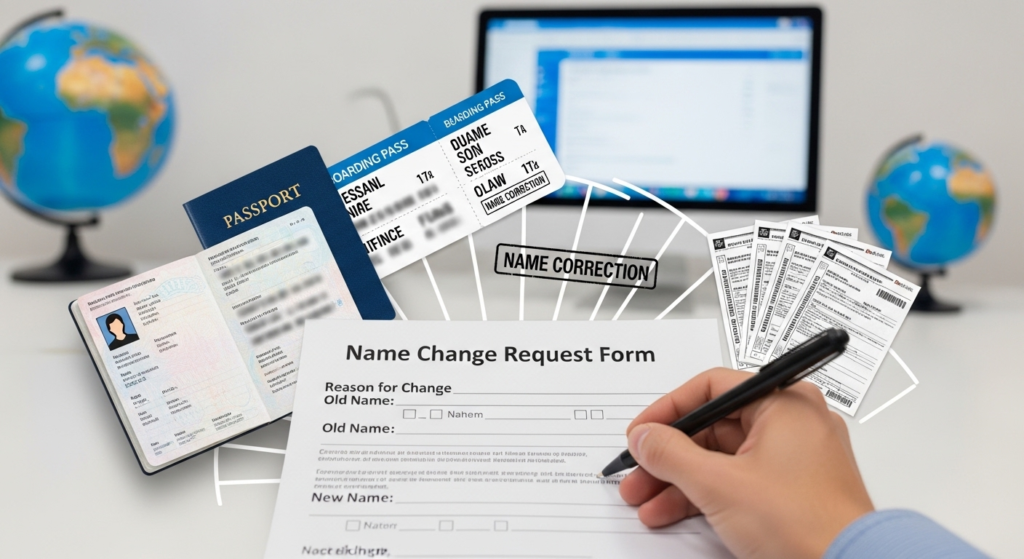
Before diving into airline-specific policies, it’s important to understand that there’s a significant difference between a name correction and a name transfer. Airlines treat these very differently.
Name Correction refers to fixing a minor spelling error, a transposed letter, or a missing middle name. Most airlines allow this, though fees may apply. Examples include changing “Sarha” to “Sarah,” or fixing “Micheal” to “Michael.”
Name Transfer means moving the ticket from one passenger to another entirely for example, if you can no longer travel and want to give the ticket to a friend or family member. This is far more restricted and most full-service airlines do not allow it at all, as tickets are non-transferable by default.
Legal Name Change covers situations where a passenger has legally changed their name due to marriage, divorce, court order, or gender transition. Airlines generally accommodate these changes with documentation, though the process and fees differ.
General Rules Most Airlines Follow
While policies vary, here are the principles that apply almost universally across airlines:
- Name changes must be made before check-in closes for the flight
- Minor corrections (1–3 characters) are usually allowed with a small fee or even free
- Complete name changes or passenger substitutions are rarely permitted on non-refundable tickets
- You will typically need to contact the airline directly or visit the booking platform where you purchased the ticket
- If you booked through a third-party travel agent or OTA (Online Travel Agency), the name change must often be processed through them, not the airline
- International tickets have stricter rules than domestic tickets in most countries
- Name changes on award tickets (booked with miles or points) often have separate, stricter policies
Airline Specific Name Change Policies & Fees
Different airlines have very different approaches. Here’s a breakdown of how major global carriers handle name changes:
| Airline | Minor Correction Fee | Major Name Change | Deadline |
|---|---|---|---|
| American Airlines | Free (minor typos) | Not allowed | Before check-in |
| Delta Air Lines | Free for small errors | Not allowed | Before departure |
| United Airlines | $25–$200 depending on ticket | Not allowed (ticket reissue required) | Before check-in |
| Southwest Airlines | Free (no change fees) | Free (same passenger) | Before departure |
| British Airways | Free for minor errors | £25–£100+ | Before check-in |
| Emirates | Free for 1–3 char fixes | AED 100–500+ | Before departure |
| Air India | ₹500–₹2,000 | Case by case | Before check-in |
| IndiGo | ₹500–₹1,000 | Not allowed | Before departure |
| Ryanair | €115 per name change | €160 if at airport | Before check-in |
| Lufthansa | €25–€50 | Ticket reissue required | Before check-in |
Note: Fees and policies are subject to change. Always verify directly with the airline before initiating a name change.
Step by Step: How to Change a Name on a Flight Ticket
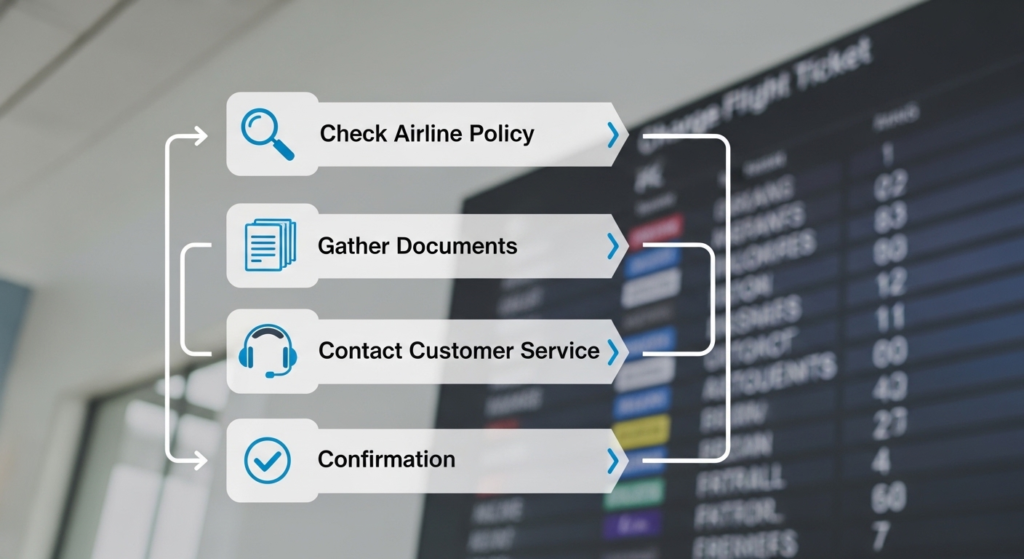
The process of getting your name corrected depends on how you booked the ticket and how significant the change is. Here’s a general roadmap:
Step 1 Identify the type of error. First, figure out exactly what needs to be corrected. Is it a typo, a legal name change, or a full passenger substitution? This determines which process applies and what documents you’ll need.
Step 2 Check the airline’s policy. Before calling anyone, visit the airline’s official website and look for their name change or name correction policy under the “Manage My Booking” or “Help Center” section. This saves time and sets expectations.
Step 3 Contact the right party. If you booked directly with the airline, call their customer service or use the online manage-booking portal. If you booked through a travel agency or OTA like Expedia, MakeMyTrip, or Cleartrip, you must contact them first they hold the ticket and need to coordinate with the airline on your behalf.
Step 4 Gather the required documents. Depending on the situation, you may need:
- A copy of your valid passport or government-issued ID
- Marriage certificate (for name change after marriage)
- Divorce decree (for reverting to a maiden name)
- Court order (for legal name changes)
- Affidavit or statutory declaration in some countries
Step 5 Submit the request. Make the request as early as possible. Many airlines have deadlines often 24 to 72 hours before departure beyond which no changes can be made.
Step 6 Pay the applicable fee. If a fee applies, be prepared to pay it immediately. Some airlines won’t process the change until payment is confirmed.
Step 7 Get confirmation in writing. Always ask for an updated booking confirmation or e-ticket with the corrected name. Don’t assume the change has been made until you see it reflected in your booking.
Name Change Fees: What to Realistically Expect
Fees vary enormously based on the airline, the type of ticket, the route, and how far in advance you make the request. Here’s a general fee structure to set expectations:
| Type of Change | Typical Fee Range | Notes |
|---|---|---|
| Minor typo (1–2 characters) | Free – $25 | Most airlines waive this |
| Spelling correction (3+ chars) | $25 – $150 | Varies by airline and ticket class |
| Legal name change (marriage/divorce) | Free – $200 | Documentation required |
| Full name change / passenger swap | Not allowed or $200–$500+ | Often requires new ticket purchase |
| Name change at the airport | $100 – $300+ | Always more expensive; avoid if possible |
| International vs. domestic | Higher for international | Fare rules are stricter on intl. routes |
One thing passengers often overlook is that even if the airline’s name change fee itself is modest, you might also face a fare difference charge if the ticket needs to be reissued. If the current fare on your travel date is higher than what you originally paid, you’ll likely need to pay the difference on top of the change fee.
Budget vs Full Service Airlines: A Key Difference
Budget airlines are notoriously strict about name changes, and they often turn what should be a simple correction into an expensive ordeal.
Low-cost carriers like Ryanair, Spirit, Frontier, and AirAsia tend to charge much higher name change fees than full-service carriers sometimes more than the original ticket cost. Ryanair, for example, charges €115 for a name change made online, and that jumps to €160 if done at the airport. In many cases, it’s cheaper to just cancel the ticket (if it’s refundable) and rebook with the correct name.
Full-service carriers like Emirates, Singapore Airlines, Lufthansa, and British Airways generally have more passenger-friendly policies, especially for minor corrections, though they’re still strict about full name transfers.
Southwest Airlines stands out as the most flexible major carrier in the U.S. they allow free name corrections and have no change fees at all, making them the easiest airline to deal with if you’ve made a booking error.
Special Situations: What to Do in These Cases
After Marriage or Divorce: If you’ve recently married or divorced and your passport still has your old name, the safest approach is to travel under your old name (as it appears on your passport) and carry your marriage certificate as supporting documentation. However, if your passport has already been updated to reflect your new legal name, you’ll need to update your ticket to match. Contact the airline with your marriage certificate or divorce decree, and the change is usually processed free of charge or for a nominal fee.
Passport Renewal with Name Change: If your passport was renewed and your name was corrected or updated (even slightly) in the process, you need to update your ticket immediately to match. This is treated as a legal correction and most airlines accommodate it with documentation.
Infant or Child Tickets: Name corrections for children follow the same rules as adults. Ensure the name on the ticket matches the child’s passport exactly, especially for international travel.
Group Bookings: Group bookings often have their own separate terms and conditions. Name changes in group tickets sometimes have different deadlines and fees. Always consult the group booking coordinator or the airline’s group travel desk.
How to Avoid Name Issues in the First Place
Prevention is always better than cure. Here are the most effective ways to avoid name-related issues when booking flights:
- Always book using your full legal name exactly as it appears on your passport or travel ID
- Double-check the name field before confirming the booking don’t rush through the payment screen
- If booking for someone else, ask them to spell their name out for you letter by letter
- Avoid using nicknames or shortened versions of your name
- Check your confirmation email immediately after booking and report any discrepancy within 24 hours
- If your name has special characters (accents, hyphens, apostrophes), confirm how the airline handles these most systems strip them out, which is usually acceptable
What Happens If You Show Up at the Airport with a Name Mismatch

This is where things can get stressful. If the name on your ticket doesn’t match your ID and you haven’t corrected it in advance, the outcome depends on the airline, the country, and the individual check-in agent.
In some cases particularly for minor discrepancies the agent may manually override and issue a boarding pass. In other cases, you could be denied boarding entirely and forced to purchase a new ticket at the airport’s walk up fare, which is almost always significantly more expensive. Security agencies in certain countries are stricter than others about this, so don’t leave it to chance.
If you discover a name mismatch at the airport, immediately approach the airline’s check in counter not the gate and explain the situation calmly. Bring all relevant documentation. The earlier you flag it, the better your chances of resolving it without missing your flight.
Quick Reference: Name Change Do’s and Don’ts
- Do check your ticket name immediately after booking
- Do contact the airline or travel agent as early as possible
- Do carry supporting legal documents for name change requests
- Do get written confirmation after any name change is made
- Do verify the corrected name on your boarding pass at check in
- Don’t wait until the day of travel to report a name error
- Don’t assume a small typo won’t matter at the airport
- Don’t try to transfer a ticket to another person without checking if it’s allowed
- Don’t book using a nickname or informal version of your name
- Don’t ignore confirmation emails always review them thoroughly
If your issue is not the name but the travel date, see the complete reschedule flight guide.
Final Thoughts
Changing a name on a flight ticket isn’t always simple, but it’s rarely impossible if you act quickly and follow the right process. The key takeaways are simple: check your booking confirmation the moment you receive it, know the difference between a minor correction and a full name change, understand your airline’s specific policy, and always initiate the process well before your travel date. The earlier you catch an error, the cheaper and easier it is to fix. Leaving it until the day of travel is where passengers get burned financially and logistically.
Travel smart, book carefully, and always make sure the name on your ticket says exactly what your passport says. Safe travels.